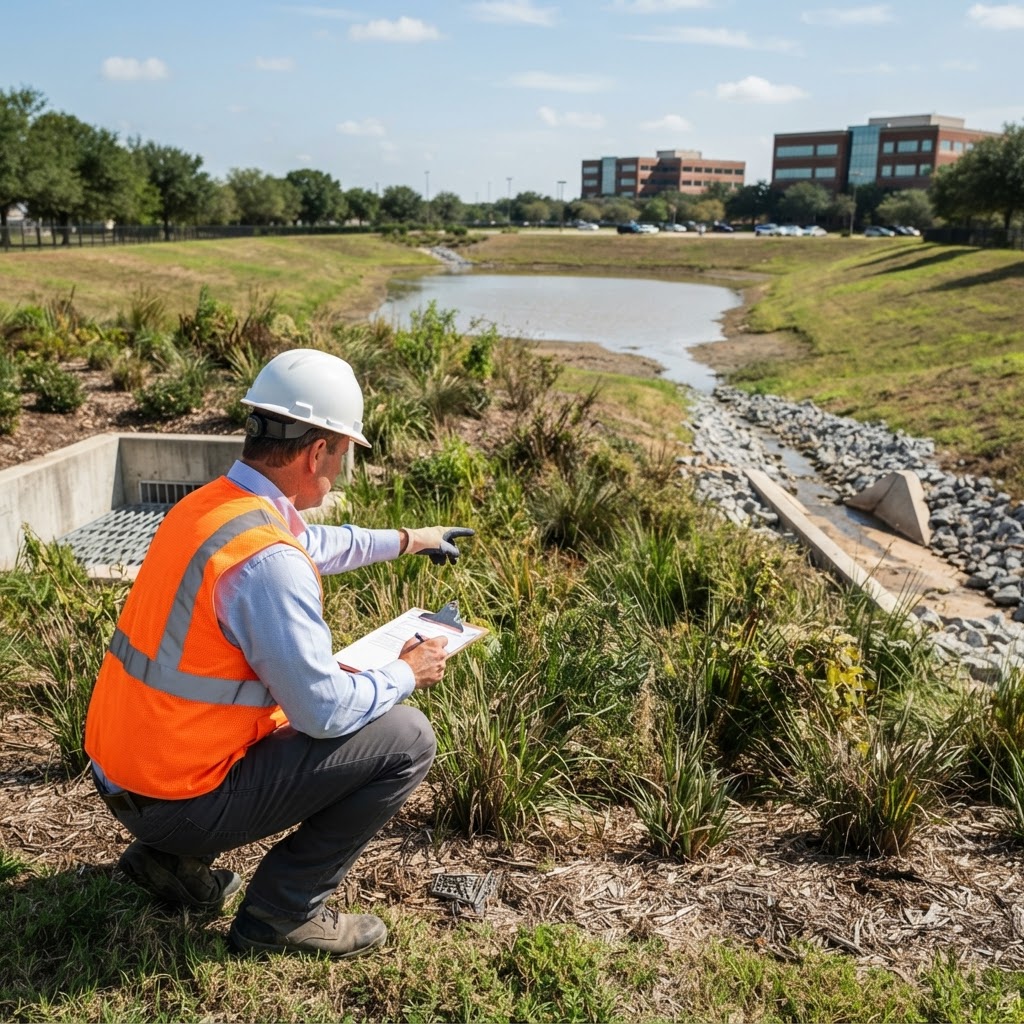
Annual Stormwater Quality Inspections and SWQ Permit Renewals in Houston and Harris County
Commercial properties with a Stormwater Quality Permit may need annual renewal documents and inspection certification. Learn what the engineer evaluates, which records the owner should provide, and how to prepare the site.
Some commercial and multi-family properties in Houston and Harris County operate under a Stormwater Quality Permit associated with permanent stormwater quality features. These permits and their approved Stormwater Quality Management Plan may require continuing inspection, maintenance, certification, and renewal as part of long-term stormwater management.
Harris County states that, after a Stormwater Quality Permit receives a Certificate of Compliance and enters operation, the permit must be renewed annually. The renewal is due on or before the anniversary date of the Certificate of Compliance.
Property owners and managers should identify the renewal date in advance. Waiting until the permit has expired can make it harder to obtain records, complete maintenance, schedule an engineer, and prepare the required documents.
What is a Stormwater Quality Permit?
A Stormwater Quality Permit addresses permanent measures intended to reduce pollutants carried by runoff from a developed property.
The approved system may include structural and nonstructural controls such as:
- Stormwater quality basins
- Detention facilities with water-quality components
- Vegetated controls
- Filtration systems
- Hydrodynamic separators
- Inlet inserts
- Underground treatment units
- Oil and sediment separation systems
- Other approved permanent best management practices
The applicable feature and inspection requirements are established by the approved civil plans, Stormwater Quality Management Plan, permit documents, and reviewing jurisdiction.
A drainage design or detention pond facility does not automatically have a Stormwater Quality Permit. The owner should verify the property's approved plans and permit records.
Who is responsible for renewal?
Responsibility generally remains with the permittee, owner, operator, or another party identified in the approved permit documents.
A property-management company may coordinate inspections and maintenance, but the legal responsibility does not necessarily transfer unless the permit is formally transferred or updated through the applicable jurisdiction.
Owners should confirm:
- Name of the current permittee
- Permit number
- Property address
- Certificate of Compliance date
- Annual renewal date
- Approved stormwater feature
- Required inspection frequency
- Maintenance responsibilities
- Whether ownership or operator information has changed
Harris County provides a separate process for transferring an SWQ permit. A property sale does not necessarily update the permit automatically.
What does the annual engineer inspection evaluate?
The inspection scope should follow the approved Stormwater Quality Management Plan and renewal requirements. Depending on the system and accessible conditions, the professional engineer may evaluate:
- General condition of the stormwater quality feature
- Consistency with the approved plans
- Visible structural damage
- Sediment accumulation
- Trash, debris, and floatables
- Standing water
- Erosion
- Bank or side-slope condition
- Vegetation and mowing
- Inlets and outlets
- Grates, manholes, and access points
- Pipes and visible connections
- Outfall condition
- Signs of blockage
- Evidence of unauthorized discharge
- Maintenance performed since the previous inspection
- Whether the feature remains accessible for inspection and maintenance
An annual inspection is generally based on visible and accessible conditions. Underground or concealed components may require maintenance records, manufacturer reports, cleaning documentation, video inspection, or other evidence.
The professional engineer cannot certify a feature that cannot be adequately evaluated or that has unresolved deficiencies.
Common deficiencies found during inspections
Conditions vary by property and stormwater feature. Common maintenance concerns may include:
- Excessive sediment
- Trash or debris
- Blocked inlets or outlets
- Overgrown vegetation
- Dead or missing vegetation
- Eroded slopes
- Standing water beyond the system's intended operation
- Damaged concrete
- Displaced riprap
- Missing or damaged grates
- Inaccessible manholes
- Damaged fencing or access gates
- Unauthorized storage in the stormwater area
- Evidence of oil or other pollutants
- Missing maintenance records
- Changes that do not match the approved plans
Finding a deficiency does not always mean the entire system must be replaced. Cleaning, mowing, sediment removal, erosion repair, component replacement, or additional investigation may resolve the issue.
Required work should be based on the approved design and observed condition.
Maintenance before the annual inspection
Property owners should not wait for the inspection to begin routine maintenance. The approved Stormwater Quality Management Plan may require inspections or maintenance more frequently than once per year.
Before the professional engineer's annual visit, the owner or property manager should:
- Locate the current permit and approved SWQMP.
- Confirm the renewal deadline.
- Review inspection and maintenance records.
- Remove ordinary trash and debris.
- Confirm that the feature is safely accessible.
- Arrange routine mowing or vegetation maintenance.
- Locate cleaning records and disposal documentation.
- Identify repairs completed during the permit year.
- Inform the engineer of known problems or changes.
- Provide access to underground or secured components.
Owners should not modify the approved stormwater feature without confirming whether revised plans or an amended permit are required.
Documents commonly needed for renewal
The exact package depends on the jurisdiction and permit. Common records may include:
- Current Stormwater Quality Permit
- Certificate of Compliance
- Approved civil plans
- Approved Stormwater Quality Management Plan
- Previous renewal documents
- Annual professional engineer inspection certification
- Owner or permittee maintenance certification
- Inspection records
- Maintenance logs
- Cleaning reports
- Disposal manifests
- Photographs
- Repair documentation
- Current owner and permittee information
- Applicable renewal application
- Required filing fee
The owner should provide the complete approved plan set when available. A prior certificate alone may not contain enough information to evaluate the feature.
What if the original plans are missing?
Missing records can delay the inspection and renewal. The engineer needs to understand what system was approved and the criteria used for its operation and maintenance.
If the owner cannot locate the records, possible next steps may include:
- Searching prior permit files
- Contacting the previous owner or property manager
- Requesting documents from the original civil engineer
- Reviewing jurisdiction records
- Obtaining available as-built plans
- Performing additional site documentation
Available records should be reviewed before assuming that an existing feature matches the approved design.
What if the permit has expired?
An expired permit should be addressed promptly. The required process depends on the jurisdiction, permit history, system condition, and length of time since the last renewal.
The reviewing authority may request current inspection documentation, maintenance records, an updated application, corrected ownership information, outstanding fees, or other materials.
Neither the owner nor engineer should represent that inspections occurred during previous years when adequate documentation is unavailable.
Annual renewal versus final inspection
An annual SWQ permit renewal is different from the initial final inspection of a newly constructed stormwater quality feature.
The initial process generally establishes that the feature was constructed and accepted according to the approved documents. Annual renewal addresses its continuing operation, maintenance, and condition after the Certificate of Compliance has been issued.
Harris County states that a separate county inspection is not necessary during the renewal phase. The renewal package requirements still apply, including the documents identified by the County.
Properties that may need this service
Annual stormwater quality inspection and renewal services may apply to:
- Shopping centers
- Office developments
- Apartment communities
- Warehouses
- Industrial properties
- Medical facilities
- Schools
- Religious facilities
- Hotels
- Automotive facilities
- Mixed-use developments
- Homeowners associations
- Privately maintained commercial developments
The presence of one of these property types does not automatically mean an SWQ permit exists. The permit status should be verified from the property's records or the applicable jurisdiction.
Information to send when requesting an inspection
To obtain an accurate proposal, provide:
- Property name and address
- Contact information for the owner or property manager
- Stormwater Quality Permit number
- Certificate of Compliance
- Renewal or expiration date
- Approved civil plans
- Approved SWQMP
- Previous annual inspection report
- Maintenance and cleaning records
- Photographs of the stormwater feature
- Gate, roof, manhole, or equipment-access requirements
- Any notices or comments received from the jurisdiction
If some documents are unavailable, identify what is missing so record research or additional investigation can be included in the scope.
How ALFA Engineering can help
ALFA Engineering provides annual stormwater quality inspections and SWQ permit-renewal support, along with broader civil engineering consulting, for qualifying commercial, multi-family, and private developments in Houston and Harris County.
Services may include:
- Review of available permit documents
- Annual site inspection by a licensed professional engineer
- Evaluation of visible stormwater quality features
- Identification of maintenance deficiencies
- Inspection photographs
- Professional engineer certification when supported by the inspection
- Assistance assembling the renewal package
- Support responding to jurisdiction comments
- Coordination of follow-up inspection after maintenance or repairs
Certification cannot be issued when the observed condition or available records do not support it. Permit acceptance and processing time remain under the authority of the applicable jurisdiction.
Send ALFA Engineering the property address, SWQ permit, approved plans, renewal date, and most recent inspection records to schedule an annual inspection.
Schedule Your Annual SWQ Inspection
Request an SWQ Permit Renewal Quote
Official Resources
- Harris County Office of the County Engineer — Stormwater Quality Permitting
- Harris County Office of the County Engineer — Permit Renewals and Transfers
- Texas Commission on Environmental Quality — Stormwater Permits
Engineering Services Across Texas
Annual stormwater quality inspections and permit renewals apply to commercial and multi-family properties with approved permanent stormwater features. While this article focuses on Harris County's Stormwater Quality Permit program, owners and managers of properties in Houston, Dallas and Fort Worth, Austin, and San Antonio should confirm their local MS4 and stormwater quality maintenance requirements, which vary by city and county.
If your property has an SWQ permit approaching its renewal date, request a consultation with a licensed Professional Engineer. Call 832-573-0305 or schedule your annual SWQ inspection.
Related Services
Check your Texas property with ALFAP TX
Run a free preliminary property and permit check — jurisdiction, flood zone, TDI windstorm, drainage, and possible engineering needs.
Request a Project Review
Send your property address, previous and proposed use, building area, available plans, and any agency comments. ALFA Engineering will review the request and contact you regarding the appropriate engineering scope.