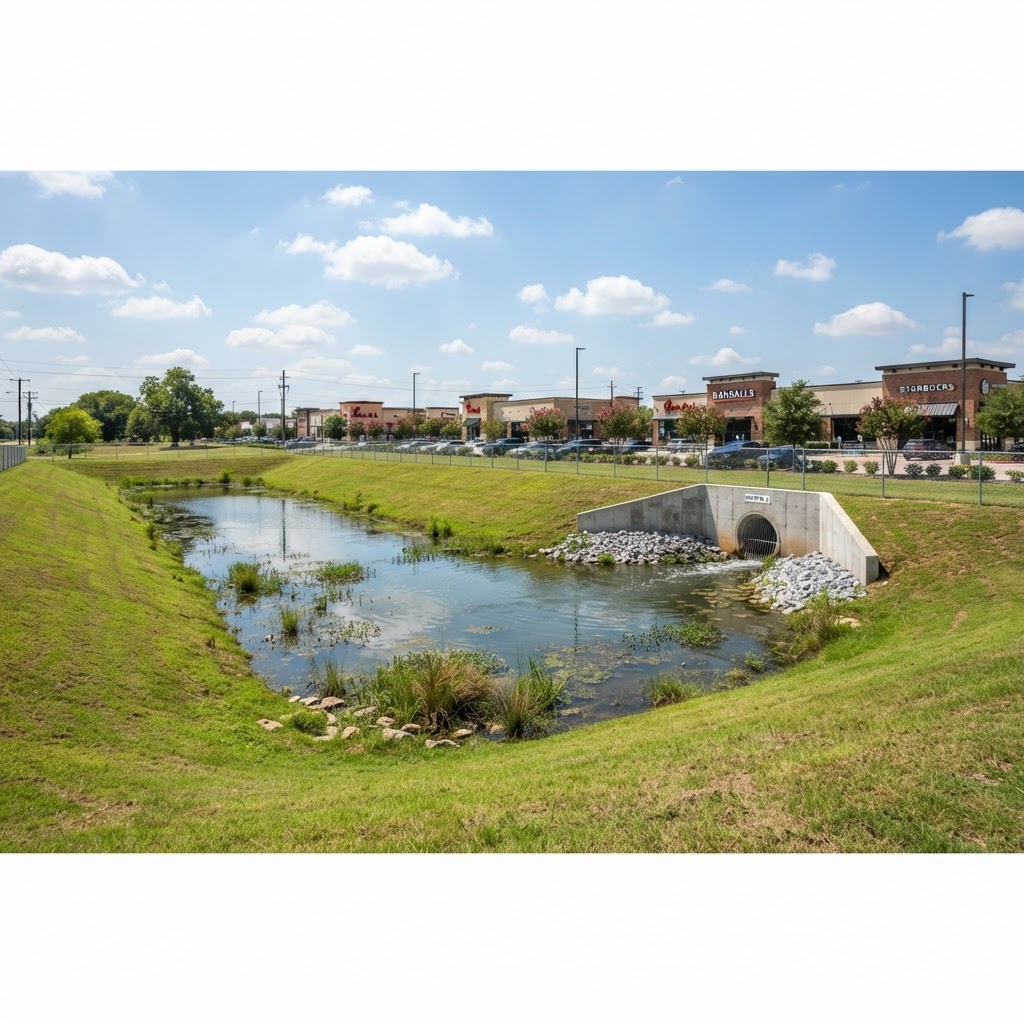
Detention Pond Maintenance: What Texas Property Owners Need to Know
If your commercial or residential development has a detention pond, it is a legal obligation as much as a landscape feature. Here is what routine maintenance actually involves, why regulators care, and what happens when it is neglected.
Detention ponds are everywhere in Texas developments — and most of them are quietly falling out of compliance. If you own or manage property with a stormwater detention or retention basin, here is what you need to know.
Why detention ponds exist
When land is developed, rooftops, pavement, and compacted soil prevent rainfall from soaking into the ground. A detention pond temporarily stores that increased stormwater runoff and releases it at a controlled rate, so downstream drainage systems — and your neighbors — are not overwhelmed. Your city or county approved your development on the condition that this pond keeps functioning. That makes maintenance a legal obligation, not landscaping preference.
What maintenance actually involves
A detention pond only works if water can get in, get out, and be stored in between. Routine maintenance means:
- Keeping the inlet and outfall structures clear. Trash, sediment, and vegetation around the inflow pipes and the outfall structure (the engineered opening that controls the release rate) are the most common cause of pond failure.
- Removing sediment buildup. Sediment reduces storage volume. When a pond has lost significant capacity, it no longer meets the design the city approved.
- Managing vegetation — selectively. Native grasses on the embankments prevent erosion and should stay; trees and woody growth on the embankment or around control structures can damage them and must go.
- Protecting the embankments. No mowing scalps, no vehicle traffic, and no dumping. Erosion on the embankment is a structural issue, not a cosmetic one.
- Inspecting after major storms. Texas downpours move sediment fast. A quick walk of the pond after a big event catches problems while they are still cheap.
What happens when maintenance is neglected
Municipalities in Texas inspect permitted stormwater facilities, and the consequences of a failed inspection are real: notices of violation, fines, and in some cases the requirement to reconstruct the facility. If the pond is tied to a Texas Commission on Environmental Quality (TCEQ) permit, such as a stormwater quality authorization, non-compliance can put the permit itself at risk.
Neglect also compounds. A pond that silts up over five years can cost ten times more to restore than it would have cost to maintain.
The takeaway
Keep records of your inspections and maintenance. Photograph the outfall, log the sediment levels, and keep the embankments healthy. If your pond shows signs of capacity loss, embankment erosion, or damaged control structures, a licensed engineer can assess whether it still performs as permitted — and design repairs or improvements where it does not.
ALFA Engineering designs and evaluates stormwater detention facilities across Texas and supports property owners with stormwater quality inspections and renewal requirements. If you are unsure whether your facility still complies, that is exactly the kind of question we answer every week.
Engineering Services Across Texas
Detention and retention pond maintenance and inspection requirements apply to developed properties across Texas, with each city and county enforcing its own stormwater ordinance. Alfa Engineering supports property owners, HOAs, and managers with pond inspection and maintenance documentation in Houston, Dallas and Fort Worth, Austin, and San Antonio.
If your property's detention pond needs inspection or maintenance documentation, request a consultation. Call 832-573-0305 or request a stormwater inspection.
Check your Texas property with ALFAP TX
Run a free preliminary property and permit check — jurisdiction, flood zone, TDI windstorm, drainage, and possible engineering needs.
Request a Project Review
Send your property address, previous and proposed use, building area, available plans, and any agency comments. ALFA Engineering will review the request and contact you regarding the appropriate engineering scope.