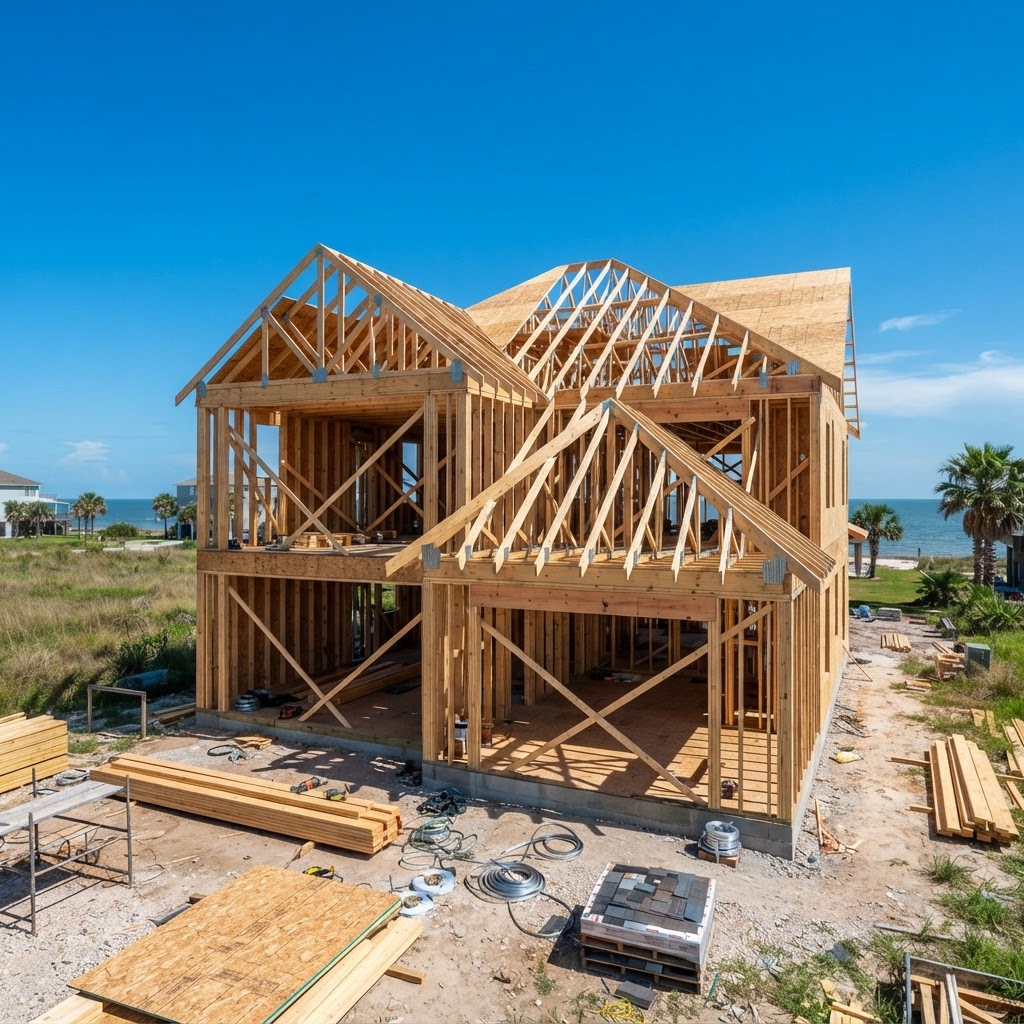
TDI Windstorm Inspections in Texas: What Property Owners Need to Know Before Construction
Properties in designated coastal areas of Texas may need windstorm inspections for certain construction, repairs, and alterations. Learn how the WPI-8 and WPI-8-E processes work and why inspection planning should begin before construction.
Properties in designated coastal areas of Texas may need a windstorm inspection and a Certificate of Compliance for certain construction, repairs, or alterations. Planning the inspection before work begins can make the certification process more straightforward and reduce the risk of concealed construction that cannot be verified later.
Property owners reading this guide usually have one of two needs: arranging a windstorm inspection for current or planned construction, or looking up an existing Certificate of Compliance for a property. The sections below cover both, and explain the difference between the two.
What is a WPI-8?
A WPI-8 is a Certificate of Compliance issued for qualifying construction that is inspected while the work is in progress. According to the Texas Department of Insurance, inspections for ongoing construction can be performed by a TDI windstorm inspector or an appointed Texas licensed professional engineer.
The certificate documents that the inspected work complies with the applicable windstorm requirements. It may also be required for the property to qualify for wind and hail insurance through the Texas Windstorm Insurance Association.
Property owners should not assume that obtaining a local building permit automatically satisfies the TDI windstorm requirements. Cities and counties establish their own building-permit procedures, while TDI administers a separate windstorm certification process.
What is a WPI-8-E?
A WPI-8-E applies to completed construction. This process is used when relevant work has already been completed without receiving the necessary windstorm inspections while construction was underway.
A Texas licensed professional engineer must evaluate the completed work and submit the required documentation. Depending on the project, the engineer may need photographs, construction records, product information, plans, contractor documentation, or access to concealed structural components.
TDI identifies a signed WPI-2E application and a sealed post-construction inspection report with supporting documentation, or a sealed design, as part of the completed-construction submission.
Because completed work can be difficult to verify, obtaining a WPI-8-E may require more investigation than arranging inspections during construction. Certification cannot be guaranteed until the available evidence and completed construction have been evaluated.
Which projects may require a windstorm inspection?
TDI states that many projects involving new construction, roof replacement, major repairs, additions, and structural alterations require an inspection and Certificate of Compliance.
Examples may include:
- New residential or commercial construction
- Roof replacement
- Building additions
- Window and exterior-door replacement
- Structural repairs
- Exterior wall modifications
- Installation of certain attached structures
- Other work affecting the building's wind-resistant components
Some minor or nonstructural work may not require a windstorm inspection. TDI lists examples of work that does not require an inspection, including roof repairs under 100 square feet that do not involve decking, painting, carpeting, cabinets and other nonstructural items, fence, gutter, decorative-shutter, step, and screen-door replacement, plumbing and electrical repairs, and glass replacement in windows or doors. The determination depends on the property location and exact construction scope. Confirm whether your specific scope requires certification with TDI.
Before beginning work, the owner or contractor should confirm whether the property is within a designated catastrophe area and whether the proposed work requires certification.
Is every property in Harris County included?
No. TDI's designated catastrophe area does not include all of Harris County.
TDI states that, unlike most participating coastal counties, only designated portions of Harris County are included in the windstorm program. The structure must be located east of Highway 146 and within the city limits of communities identified on the applicable TDI map.
Property owners should verify the project address using current TDI information rather than relying only on the county name, ZIP code, or distance from the coast.
Which building codes currently apply?
For Certificate of Compliance applications submitted on or after April 1, 2026, TDI requires certification under either the 2024 International Residential Code or the 2024 International Building Code.
The applicable requirements depend on factors such as:
- Building type and occupancy
- Project location
- Applicable wind zone
- Wind exposure
- Building height and geometry
- Construction materials
- Openings and exterior components
- Windborne-debris requirements
The engineer or inspector should confirm the applicable criteria for the specific project.
When should the inspection process begin?
The windstorm inspection process should be coordinated before construction begins. TDI states that an application for a Certificate of Compliance must be submitted before starting construction.
Early coordination allows the inspector to identify the required inspection stages. These inspections may need to occur before roofing, wall finishes, insulation, ceilings, or other materials conceal structural connections.
Items that may require inspection include:
- Foundation anchorage
- Wall framing and connections
- Roof framing
- Roof-to-wall connections
- Sheathing attachment
- Exterior openings
- Roofing installation
- Approved products and fastening patterns
The exact inspection stages depend on the construction scope.
Recommended steps before construction
Property owners and contractors should take the following steps:
- Confirm whether the property is in a designated catastrophe area.
- Define the complete construction scope.
- Contact an appointed engineer or TDI windstorm inspector.
- Submit the required Certificate of Compliance application before beginning construction.
- Provide plans, product information, and contractor details when requested.
- Schedule inspections before relevant work is concealed.
- Retain photographs, approved plans, product approvals, and construction records.
- Verify that the Certificate of Compliance has been issued after the required documentation is accepted.
Beginning construction without coordinating the inspection can lead to delays and additional investigation. If construction is already complete, a Texas licensed professional engineer must determine whether sufficient evidence is available to support a completed-construction certification application.
Looking up an existing certificate
Looking up an existing Certificate of Compliance is different from arranging an inspection. A certificate search only retrieves records TDI has already issued; it does not schedule, perform, or expedite an inspection, and it cannot create a certificate for construction that has not been inspected.
Anyone can search the public TDI database — you do not need an engineer to look up a certificate.
- WPI-8 and WPI-8-E certificates (issued by TDI): Search the TDI Windstorm system certificate search by application or certificate number, or by property address.
- WPI-8-C certificates (issued by TWIA between January 1, 2017 and May 31, 2020): Use the TWIA certificate lookup tool. These records are not in TDI's database.
If no certificate is found, the structure may not have been inspected under the TDI windstorm program, or the inspection may not have resulted in a certificate. In that case, arranging an inspection (or a completed-construction evaluation) is a separate step — see the guidance above and the request section below.
ALFA Engineering does not issue or maintain the certificate database and is not affiliated with TDI. For help finding a certificate, contact TDI's Windstorm Program at 800-248-6032 or Windstorm@tdi.texas.gov.
ALFA Engineering's windstorm services
ALFA Engineering provides windstorm inspection and certification support for qualifying residential and commercial projects in the Texas designated catastrophe area. Services that may be included in a proposal are:
- Reviewing the project location and confirming whether it is in the TDI designated catastrophe area
- Determining the applicable inspection process (ongoing or completed construction)
- Preparing or reviewing engineering plans for windstorm compliance
- Coordinating required inspection stages before work is concealed
- Performing eligible windstorm inspections as a Texas licensed professional engineer
- Preparing supporting engineering documentation
- Assisting with WPI-8 or WPI-8-E submissions, as applicable
ALFA Engineering is an independent Texas licensed engineering firm and is not affiliated with, endorsed by, or acting on behalf of TDI. TDI makes the final certificate determination. Certification cannot be guaranteed and depends on the project conditions, available documentation, inspection results, and TDI requirements.
Request a Windstorm Inspection
To request a windstorm inspection, include at a minimum:
- Property address
- Proposed or completed work (new construction, roof replacement, addition, structural repair, or other)
- Construction stage (not started, in progress, or complete)
- Available plans, product approvals, or existing certificates (if any)
You do not need every document to start the conversation. Share what you have and ALFA Engineering will help identify what else is needed. Use the Request a Windstorm Inspection button on this page to submit your information.
Official Resources
- TDI — Certificate of Compliance Search (WPI-8 and WPI-8-E)
- TWIA — WPI-8-C Certificate Lookup (Jan 2017–May 2020)
- TDI — List of Appointed Qualified Inspectors
- Texas Department of Insurance — What You Need to Know About Windstorm Inspections
- Texas Department of Insurance — Windstorm System Information
- Texas Department of Insurance — Adopted Building Codes
- Texas Department of Insurance — Designated Catastrophe Areas
- Texas Department of Insurance — Completed Construction Certificates
- Texas Department of Insurance — When an Inspection Is Not Required
Engineering Services Across Texas
TDI windstorm inspections and WPI-8 certificates apply only to structures within the Texas Department of Insurance designated catastrophe area along the Gulf Coast, including the greater Houston region and coastal counties. Properties in inland markets such as Dallas–Fort Worth, Austin, and San Antonio are outside the designated catastrophe area and do not require TDI windstorm certifications.
If your coastal construction project requires a windstorm inspection or WPI-8 certificate, request an inspection with a licensed Professional Engineer. Call 832-573-0305.
Related Services
Check your Texas property with ALFAP TX
Run a free preliminary property and permit check — jurisdiction, flood zone, TDI windstorm, drainage, and possible engineering needs.
Request a Windstorm Inspection
Send your property address, proposed or completed work, construction stage, and any available plans or certificates. ALFA Engineering will review the request and contact you regarding the windstorm inspection.